
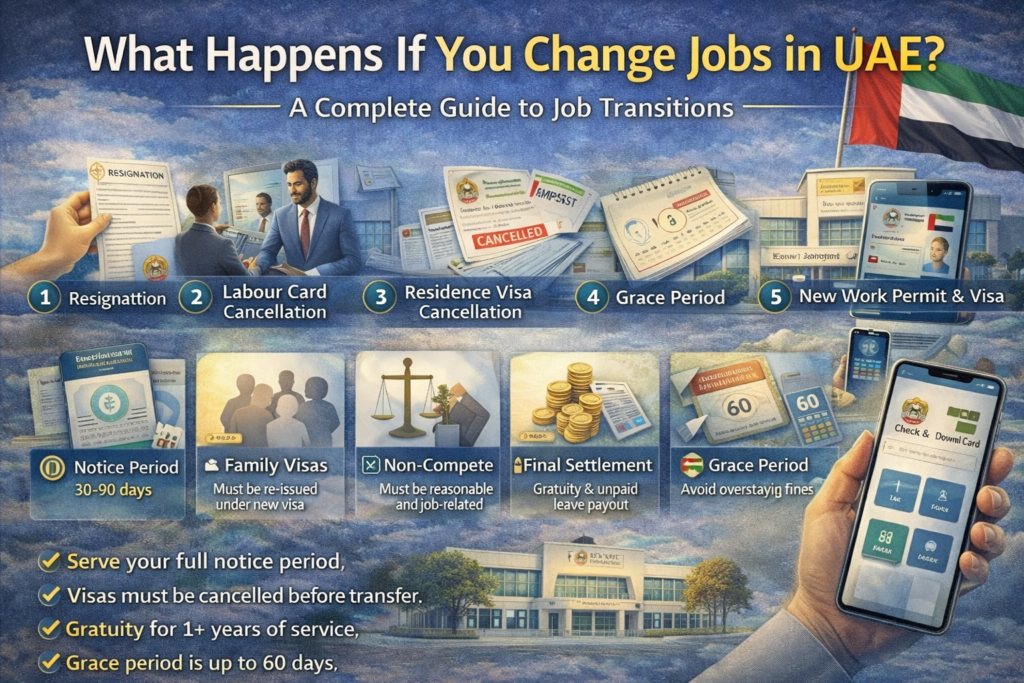
Changing jobs in the UAE is a structured legal process. Whether you are resigning voluntarily, accepting a better offer, or transitioning between employers, it is important to understand what happens at each stage to avoid fines, visa complications, or contractual disputes.
This guide explains everything you need to know about what happens if you change jobs in UAE, including notice periods, visa cancellation, non-compete clauses, gratuity calculations, and family visa implications.
Understanding Your Employment Contract
Under UAE labour law (Federal Decree-Law No. 33 of 2021), all private sector employment contracts are fixed-term contracts. Every agreement must specify a start and end date.
Although older contracts may still reference “unlimited contracts,” they are now treated as fixed-term under the current legal framework.
Your contract determines:
- Notice period length
- Non-compete obligations
- Gratuity entitlement
- Probation conditions
Always review your signed employment agreement before resigning.
The Job Change Process: Step by Step
Changing jobs in the UAE follows a structured sequence.
Stage 1: Resignation and Notice Period
Once you accept a written offer from a new employer, you must formally resign from your current role.
Key Points:
- Provide written notice as per your contract (usually 30–90 days)
- Notice begins when the employer receives your resignation
- You must continue working unless released
- Failure to serve notice may require compensation
During Probation:
If you are within the probation period (maximum six months):
- You must provide at least 1 month’s notice
- Your new employer may compensate your current employer for recruitment costs
- If leaving the UAE entirely, 14 days’ notice is required
Stage 2: Labour Card Cancellation
After completing your notice period, your employer cancels your work permit (labour card) through:
Ministry of Human Resources and Emiratisation (MoHRE) for mainland companies
Or the respective free zone authority.
This step is mandatory before a new employer can issue a new permit.
Stage 3: Residence Visa Cancellation
Once the labour card is cancelled, your residence visa is cancelled through:
Federal Authority for Identity, Citizenship, Customs & Port Security (ICP)
Or GDRFA (Dubai).
This officially ends your residency under the previous employer.
Stage 4: Grace Period
After visa cancellation, you enter a grace period—typically up to 60 days.
During this period, you can:
- Stay legally in the UAE
- Complete medical tests and biometrics
- Wait for your new visa processing
If your new visa is not processed within the grace period, you must exit the country or obtain a valid alternative visa.
Overstaying may result in fines (approximately AED 500 per day).
Stage 5: New Work Permit & Visa Issuance
Your new employer will:
- Apply for a new work permit
- Arrange medical test (if required)
- Complete Emirates ID processing
- Stamp your new residence visa
- Issue your new labour card
Processing typically takes 2–4 weeks.
Important: You cannot legally start working until your new work permit is issued.
Important Considerations When Changing Jobs
1. Non-Compete Clause
Many contracts include non-compete clauses. These are enforceable only if:
- Written in your contract
- Limited in duration (maximum 2 years)
- Restricted geographically
- Limited to specific activities
- Necessary to protect legitimate business interests
Non-compete clauses may be unenforceable if:
- The employer terminated you without valid reason
- The employer breached the contract
- You were on probation
- Your role did not involve confidential access
UAE law allows a buy-out option (up to 3 months’ salary), subject to employer approval.
2. End-of-Service Gratuity
If you have completed at least one year of service, you are entitled to gratuity.
| Years of Service | Gratuity Calculation |
|---|---|
| Less than 1 year | No gratuity |
| 1–5 years | 21 days’ basic salary per year |
| 5+ years | 30 days’ basic salary per year |
Important notes:
- Calculated on basic salary only
- Capped at two years’ basic salary
- Pro-rata for partial years
3. Annual Leave Payout
You are entitled to payment for unused accrued annual leave upon termination.
Recent court decisions confirm employees may claim accumulated leave from previous years.
4. Wage Protection System (WPS)
Your final settlement must be processed through WPS.
Ensure:
- Final salary is paid
- Gratuity is transferred
- No unjust deductions are made
5. Health Insurance
Your employer’s health insurance typically ends when employment ends.
Your new employer must provide coverage.
Avoid gaps in insurance coverage.
6. Family Visas
If you sponsor family members:
- Their visas are linked to yours
- When your visa is cancelled, dependents are affected
- You must re-sponsor them after your new visa is issued
Plan transitions carefully to avoid disruption.
Special Scenarios
Mainland to Free Zone (or vice versa)
Visa cancellation must occur before new visa issuance.
Processing authorities differ:
- Mainland → MoHRE
- Free Zone → Respective authority
Coordination is important to avoid residency gaps.
Changing Jobs on Green Visa or Golden Visa
If you hold a self-sponsored visa:
- You do not need to cancel residency
- Only a new work permit is required
This offers greater mobility and flexibility.
Your Legal Rights
As an employee, you have the right to:
- Full final settlement
- Prompt visa cancellation
- Accurate gratuity calculation
- No visa-related cost deductions
- Protection against false absconding reports
Employers must:
- Cancel labour card and visa promptly
- Pay settlement in full
- Avoid filing false absconding claims
- Register new hires before work begins
Common Mistakes to Avoid
❌ Starting work before visa transfer
Illegal and may result in fines or deportation.
❌ Resigning without written offer
Always secure a formal offer first.
❌ Ignoring non-compete clause
Review before joining a competitor.
❌ Missing grace period
Overstay fines accumulate daily.
❌ Not verifying final settlement
Double-check gratuity and leave payout.
Frequently Asked Questions
Do I need an NOC to change jobs?
No. NOCs are no longer required under current UAE labour law (though some free zones may request them administratively).
How long does visa transfer take?
Typically 2–4 weeks.
Can I change jobs without leaving UAE?
Yes, most transfers can be completed in-country.
What if my employer refuses cancellation?
You may file a complaint with MoHRE.
Can I change jobs during probation?
Yes, with proper notice and compliance.
Key Takeaways
- All contracts are fixed-term under current law
- Serve your full notice period
- Labour card must be cancelled before new one is issued
- Grace period is typically 60 days
- Non-compete clauses must be reasonable
- Gratuity is based on basic salary
- Family visas are affected
- Never start working before permit approval
Final Thoughts
So, what happens if you change jobs in UAE?
In short:
- You resign and serve notice
- Your labour card is cancelled
- Your residence visa is cancelled
- You enter a grace period
- Your new employer processes a new permit
When handled properly, job transitions in the UAE are straightforward. The key is understanding your rights, fulfilling contractual obligations, and ensuring every step is legally completed.
By planning carefully and following the correct procedures, you can move to your next opportunity confidently and legally—without unnecessary stress or penalties.
For the most accurate and up-to-date information, consult official authorities such as MoHRE, ICP, or a qualified legal professional.