
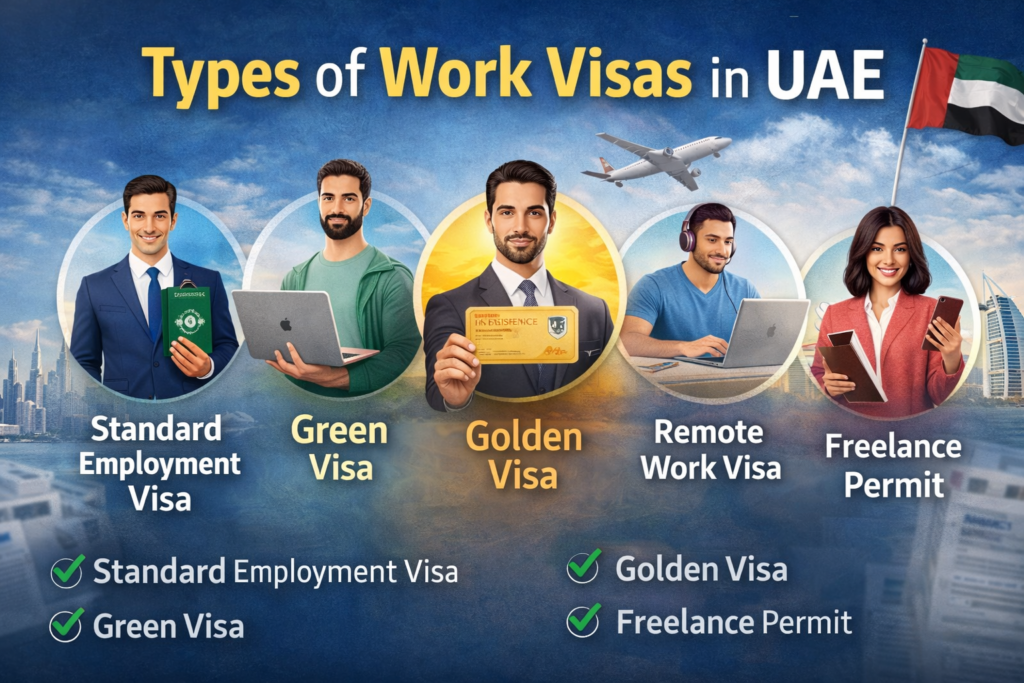
The United Arab Emirates (UAE) has positioned itself as a global hub for business, innovation, finance, tourism, and entrepreneurship. With world-class infrastructure and tax-friendly policies, cities like Dubai and Abu Dhabi attract professionals, freelancers, investors, and remote workers from across the globe.
Central to this growth is a modern and evolving visa framework designed to accommodate different professional profiles. Today, the UAE offers multiple work and residency pathways — far beyond the traditional employer-sponsored model.
This guide explains the types of work visas in UAE, who they are designed for, their key features, and how they differ.
The Golden Rule: No Work Without a Valid Permit
Before exploring specific visa categories, it is important to understand a fundamental principle of UAE labour law:
You cannot legally work in the UAE without a valid work permit issued by the Ministry of Human Resources and Emiratisation (MoHRE).
Even if you hold a residency visa (such as a dependent visa or a long-term residency visa), you must still obtain the appropriate work authorization.
The UAE recognises multiple work permit categories tailored to different employment arrangements, ensuring legal clarity for employers and employees alike.
1. Standard Employment Visa (Employer-Sponsored Visa)
This is the most common work visa in the UAE and applies to the majority of expatriate professionals.
Who Is It For?
- Employees hired by a UAE-based company
- Mainland company employees
- Free Zone company employees
Key Features
- Employer acts as sponsor
- Validity typically 2–3 years
- Renewable as long as employment continues
- Tied directly to your employer
If you resign or are terminated, the visa must either be cancelled or transferred to a new employer.
Process Overview
- Employer applies for work permit approval from MoHRE
- Entry permit is issued (if outside UAE)
- Medical fitness test
- Emirates ID application
- Residency visa stamping
This visa provides structured employment security but limits professional mobility unless formally transferred.
2. Green Visa (Self-Sponsored Residency for Skilled Professionals)
The Green Visa represents a significant shift toward professional independence. Unlike traditional employment visas, it does not require an employer sponsor.
Who Is It For?
The Green Visa typically targets:
Skilled Employees
- Valid UAE employment contract
- Classified under skilled labour categories
- Bachelor’s degree or equivalent
- Minimum salary threshold (as defined by authorities)
Freelancers & Self-Employed Professionals
- Valid freelance permit
- Proof of professional qualifications
- Demonstrated income history or financial solvency
Investors & Commercial Partners
- Individuals investing in or establishing commercial activities
- Approval from relevant authorities
Key Benefits
- 5-year renewable residency
- Self-sponsorship
- Greater career flexibility
- Extended family sponsorship rights
- Grace period after visa expiry or cancellation
The Green Visa is ideal for mid-to-high-skilled professionals who seek independence while remaining legally compliant.
3. Golden Visa (Long-Term Residency for Investors & Exceptional Talent)
The Golden Visa is a long-term residency program designed to attract high-net-worth individuals, entrepreneurs, and exceptional talent.
Who Is It For?
Eligible categories include:
- Real estate investors
- Public investment holders
- Entrepreneurs
- Scientists and researchers
- Doctors and medical professionals
- Creative artists
- Outstanding students
- Specialized professionals in strategic sectors
Key Benefits
- 5 or 10-year renewable residency
- No local sponsor required
- Ability to stay outside the UAE beyond six months without visa cancellation
- Sponsorship of immediate family members
- Enhanced stability and long-term security
This visa provides strong residency security and is suited for individuals seeking long-term settlement in the UAE.
4. Remote Work Visa (Virtual Work Residency)
As remote work becomes increasingly global, the UAE introduced a visa allowing foreign professionals to live in the country while working for overseas employers.
Who Is It For?
- Employees of companies outside the UAE
- Entrepreneurs managing overseas businesses
- Digital nomads seeking UAE residency
Key Features
- Typically valid for one year
- Self-sponsored
- Requires proof of income
- Valid health insurance required
- Proof of stable employment and income history
This visa allows professionals to enjoy the UAE lifestyle without transferring employment to a local company.
5. Freelance / Self-Employment Permit
A freelance permit is an official authorization allowing professionals to work independently in the UAE.
It may serve as:
- A standalone permit
- A foundation for applying for a Green Visa
Who Is It For?
Independent professionals in fields such as:
- Media
- Technology
- Design
- Consulting
- Education
- Marketing
Key Feature
Allows you to legally offer services to multiple clients without being tied to a single employer.
This structure supports the UAE’s growing gig economy and creative sector.
6. Other Work Permit Categories
The UAE labour framework also includes several specialised permits issued under MoHRE guidelines:
Temporary Work Permit
For short-term or project-based employment within the UAE.
Mission Work Permit
For foreign workers brought to complete specific time-bound assignments.
Part-Time Work Permit
Allows individuals to legally work for more than one employer on reduced hours.
Student & Training Permit
For students gaining practical work experience.
Juvenile Work Permit
For individuals aged 15–18, with strict labour protections.
These permits ensure flexibility while maintaining compliance with UAE labour regulations.
Green Visa vs. Golden Visa: Key Differences
| Feature | Green Visa | Golden Visa |
|---|---|---|
| Target Group | Skilled professionals & freelancers | Investors & exceptional talent |
| Validity | 5 years | 5 or 10 years |
| Sponsorship | Self-sponsored | Self-sponsored |
| Income Requirement | Salary/income threshold | Investment threshold |
| Travel Flexibility | Standard residency rules | Extended stay outside UAE allowed |
| Focus | Professional flexibility | Long-term stability |
The right choice depends on your financial profile, career path, and long-term goals in the UAE.
Choosing the Right UAE Work Visa
When deciding between visa types, consider:
- Are you employed by a UAE company?
- Do you prefer professional independence?
- Are you investing in property or business?
- Do you work remotely for an overseas employer?
- Are you seeking long-term residency security?
Each visa serves a specific professional category, and selecting the correct one ensures legal compliance and smoother residency processing.
Important Authorities to Check
For official and updated information, always refer to:
- Ministry of Human Resources and Emiratisation (MoHRE)
- Federal Authority for Identity, Citizenship, Customs & Port Security (ICP)
Visa regulations, salary thresholds, and eligibility criteria are subject to change. Consulting official portals or licensed immigration advisors is recommended.
Final Thoughts
The UAE offers one of the most diverse and flexible work visa ecosystems in the region. Whether you are a corporate employee, freelancer, investor, entrepreneur, or remote worker, there is a structured pathway designed to support your professional journey.
Understanding the different types of work visas in UAE is the first step toward building a successful and legally compliant career in the country. By choosing the correct residency route, you not only secure employment rights but also gain access to one of the world’s most dynamic economic environments.
Always verify eligibility requirements with official authorities before applying to ensure a smooth and compliant transition.
Frequently Asked Questions (FAQ) – Types of Work Visas in UAE
1. What are the main types of work visas in the UAE?
The main types of work visas in the UAE include:
- Standard Employment Visa (Employer-Sponsored)
- Green Visa (Self-Sponsored for Skilled Professionals & Freelancers)
- Golden Visa (Long-Term Residency for Investors & Exceptional Talent)
- Remote Work Visa (For overseas employees working remotely)
- Freelance / Self-Employment Permit
- Temporary, Part-Time, and Mission Work Permits
Each visa is designed for a specific professional category.
2. Can I work in the UAE without a work permit?
No. You cannot legally work in the UAE without a valid work permit issued by the Ministry of Human Resources and Emiratisation (MoHRE), even if you hold a residency visa. Work authorization is mandatory for legal employment.
3. What is the difference between a Green Visa and a Golden Visa?
The Green Visa is typically for skilled professionals, freelancers, and investors in commercial activities. It offers five-year renewable residency with self-sponsorship.
The Golden Visa is designed for high-net-worth investors, entrepreneurs, and exceptional talents. It offers longer-term residency (5 or 10 years) with enhanced benefits and greater stability.
4. Is the Standard Employment Visa tied to my employer?
Yes. The Standard Employment Visa is employer-sponsored. If you resign or are terminated, your visa must be cancelled or transferred to another employer.
5. Who is eligible for the UAE Green Visa?
The Green Visa is generally available to:
- Skilled employees with qualifying salary levels and educational credentials
- Freelancers and self-employed professionals with proof of income
- Investors participating in commercial activities
Eligibility criteria may vary based on government regulations.
6. Can freelancers legally work in the UAE?
Yes. Freelancers can obtain a freelance or self-employment permit, which allows them to legally provide services to multiple clients without being tied to one employer. This permit may also support eligibility for a Green Visa.
7. What is the Remote Work Visa in the UAE?
The Remote Work Visa allows foreign professionals to live in the UAE while working for an employer or business outside the country. Applicants must provide proof of stable income, employment history, and valid health insurance.
8. How long are UAE work visas valid?
Validity depends on the visa type:
- Standard Employment Visa: Usually 2–3 years
- Green Visa: 5 years (renewable)
- Golden Visa: 5 or 10 years (renewable)
- Remote Work Visa: Typically 1 year
All visas are subject to renewal conditions.
9. Can I sponsor my family on a UAE work visa?
Yes, most long-term residency visas (Standard Employment, Green Visa, Golden Visa) allow family sponsorship, provided income requirements are met. The Golden Visa offers extended family sponsorship privileges.
10. Where can I check official UAE visa regulations?
For the most accurate and updated information, refer to:
- The Ministry of Human Resources and Emiratisation (MoHRE)
- The Federal Authority for Identity, Citizenship, Customs & Port Security (ICP)
Visa rules, salary thresholds, and eligibility criteria may change, so always verify through official government sources.