
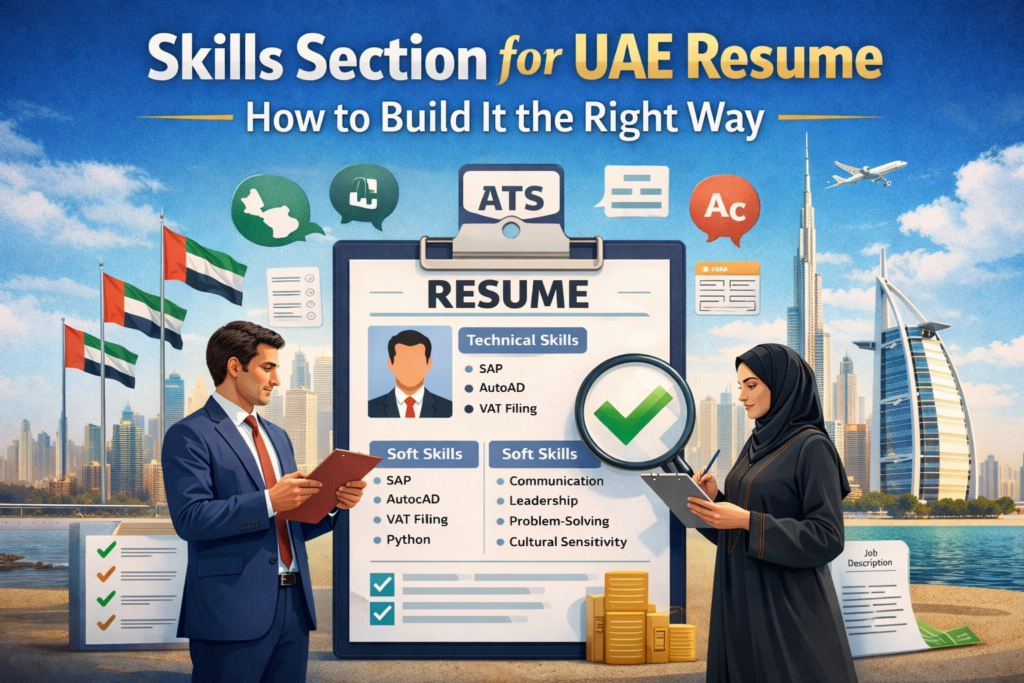
If the Professional Summary is the hook of your resume, the Skills Section is the proof.
In the UAE’s competitive job market—especially across business hubs like Dubai Internet City, Dubai Media City, and industrial zones in Abu Dhabi—recruiters don’t have time to interpret vague experience. They scan for specific technical skills, certifications, and software knowledge.
And here’s the reality:
Most companies in the United Arab Emirates use Applicant Tracking Systems (ATS) to filter resumes before a human even sees them.
If your skills section doesn’t match the job description keywords, your resume may never reach a recruiter.
This guide will show you how to create a powerful, ATS-friendly Skills Section that works across industries in the UAE.
Why the Skills Section Matters More in the UAE
The UAE workforce is global. You are competing with professionals from Asia, Europe, Africa, and beyond.
Recruiters use the skills section as a quick checklist to determine:
- Can this person perform from Day 1?
- Do they have the exact software expertise required?
- Can they operate in a multilingual environment?
- Are they aligned with UAE regulations?
1️⃣ Immediate Contribution
Companies investing in visa processing and onboarding want professionals who already have the required technical skills.
2️⃣ Language Advantage
The UAE workplace is multilingual. Mention proficiency clearly:
- English (Fluent)
- Arabic (Professional)
- Hindi / Urdu / Tagalog (Conversational)
Language ability can be a deciding factor.
3️⃣ Software Proficiency is Often Mandatory
In the UAE, software isn’t optional. If a job requires:
- SAP
- Salesforce
- AutoCAD
- QuickBooks
- Primavera
- Power BI
You must list it clearly if you possess it.
The Two Types of Skills You Must Include
A strong UAE resume balances Hard Skills (70%) and Soft Skills (30%).
1️⃣ Hard Skills (Technical Skills)
These are measurable, teachable abilities. These are what help you pass the ATS.
Examples:
Software:
- SAP
- Oracle
- MS Excel (Pivot Tables, Macros)
- AutoCAD
- QuickBooks
- Salesforce
- Adobe Photoshop
Technical Expertise:
- VAT Filing
- Corporate Tax Preparation
- SEO & SEM
- Python Programming
- Contract Negotiation
- Data Analysis
Languages:
- English (Fluent)
- Arabic (Native/Professional)
- Hindi (Conversational)
Hard skills should dominate your section.
2️⃣ Soft Skills (Interpersonal Skills)
Soft skills define how you work.
In a multicultural country like the UAE, these are highly valued:
- Communication
- Leadership
- Time Management
- Problem-Solving
- Adaptability
- Cultural Sensitivity
⚠️ Important:
Do not overload your resume with soft skills. List 3–4 maximum and demonstrate the rest in your experience section.
How to Format Your Skills Section (Best Practices for UAE)
There are three effective formats.
✅ Option A: Categorized List (Best for ATS)
This is the most recommended format.
Example – Marketing Professional
Digital Marketing: SEO/SEM, Google Ads, Meta Business Suite, Email Marketing
Analytics: Google Analytics, Data Studio, Conversion Optimization
Creative: Content Strategy, Copywriting, Basic Photoshop
Languages: English (Fluent), Arabic (Professional)
Why this works:
- Easy to scan
- Keyword-rich
- ATS-friendly
- Clean layout
✅ Option B: Core Competencies (Best for Senior Roles)
Ideal for managers and executives.
Example – Project Manager
- Stakeholder Management: Coordinating with local authorities and regulatory bodies
- Budget Management: Handling CAPEX/OPEX budgets
- Methodologies: Agile, Scrum, Waterfall
- Risk Assessment & Compliance
This provides context, not just keywords.
⚠️ Option C: Skill Bars / Meters (Use With Caution)
Visual skill bars like:
- Photoshop – 90%
- Excel – 80%
Look attractive, but ATS cannot read them.
Always include text-based keywords alongside visuals if you choose this design.
Skills Section Examples by Industry
Here are generalized examples that work in the UAE job market.
1️⃣ Sales & Business Development
CRM: Salesforce, Zoho, HubSpot
Sales Techniques: B2B Lead Generation, Cold Calling, Negotiation
Analytics: Excel (Pivot Tables, VLOOKUP)
Languages: English (Fluent), Arabic (Conversational)
2️⃣ Accounting & Finance
Core Competencies:
- VAT Filing & Corporate Tax Compliance
- IFRS Financial Reporting
- Accounts Payable & Receivable
- Payroll Processing (WPS)
Software:
- Tally ERP
- QuickBooks
- SAP FICO
- Advanced MS Excel
3️⃣ Engineering & Construction
Software: AutoCAD, Revit (BIM), Civil 3D, Primavera P6
Technical: Quantity Surveying, Site Supervision
Regulatory Knowledge: Local Municipality Standards
Project Coordination: Vendor & Contractor Management
4️⃣ IT & Digital Roles
Programming: Python, JavaScript, SQL
Cloud Platforms: AWS, Microsoft Azure
Tools: Docker, Kubernetes, Jira, Git
Security: Risk Assessment, Compliance Standards
5️⃣ HR & Administration
HR Expertise:
- UAE Labor Law Knowledge
- Visa Processing
- Onboarding & Offboarding
- Performance Management
Software:
- Microsoft Office Suite
- Document Control Systems
- WPS Management
How to Choose the Right Skills (The ATS Strategy)
Here is a simple 3-step method:
Step 1: Copy the Job Description
Highlight required skills.
Step 2: Identify Hard Keywords
Look for specific terms like:
- SAP
- AutoCAD
- DHA License
- Power BI
- PMP Certification
Step 3: Match Exactly
If the job says “Negotiation Skills,” use that exact phrase.
ATS scans for exact matches.
High-Demand Skills in the UAE
Across industries, these skills consistently trend:
- Artificial Intelligence Literacy
- Data Analytics (Power BI, Tableau)
- Corporate Tax Knowledge
- Digital Marketing
- Cloud Computing (AWS, Azure)
- Cybersecurity Compliance
- Sustainability & ESG Reporting
- CRM Software
- Project Management Certifications
- Bilingual Communication (Arabic/English)
Common Mistakes to Avoid
❌ Being Too Generic
Instead of:
MS Office
Write:
MS Excel (Advanced – Pivot Tables & Macros)
❌ Listing Outdated Skills
Remove:
- Fax operation
- Typing pool
- Old software versions
❌ Overloading Soft Skills
Avoid listing:
- Honest
- Loyal
- Hardworking
- Punctual
These do not differentiate you.
❌ Spelling Errors
Misspelling “Photoshop” or “AutoCAD” can cost you credibility instantly.
Final Checklist for Your Skills Section
Before submitting your UAE job application:
✔ Does it match the job description keywords?
✔ Have you specified software proficiency clearly?
✔ Did you include language abilities?
✔ Is it clean and easy to scan?
✔ Have you removed irrelevant or outdated skills?
Final Thoughts
Your skills section is not just a list — it is a sales tool.
In the UAE job market, employers are not just hiring experience; they are hiring capability. A strong, keyword-optimized, and clearly structured Skills Section ensures:
- You pass ATS filters
- You impress recruiters
- You position yourself as job-ready
When crafted properly, your skills section becomes the bridge between what the company needs and what you offer.
✅ Frequently Asked Questions (FAQ) – Skills Section for UAE Resume
1. How long should the skills section be on a UAE resume?
Your skills section should ideally contain 8–15 relevant skills, depending on your experience level. It should be concise, keyword-focused, and tailored to the specific job you are applying for. Avoid listing too many unrelated skills.
2. What is more important in the UAE: hard skills or soft skills?
Hard skills are more important for passing Applicant Tracking Systems (ATS). Ideally, your skills section should be 70% hard (technical) skills and 30% soft skills. Technical expertise such as SAP, AutoCAD, Excel, or VAT filing carries more weight than generic soft skills.
3. Should I include language skills in my UAE resume?
Yes. Language skills are highly valued in the United Arab Emirates because of its multicultural workforce. Clearly mention your proficiency level, for example:
- English (Fluent)
- Arabic (Professional Working Proficiency)
- Hindi (Conversational)
4. How do I make my skills section ATS-friendly?
To make your skills section ATS-friendly:
- Use exact keywords from the job description.
- Avoid images, graphics, or skill bars.
- Use clear text formatting.
- Match terminology precisely (e.g., “SAP FICO” instead of just “SAP”).
5. Can I use skill percentage bars (like 90% in Excel)?
It is not recommended. Most ATS software cannot read visual skill meters. Stick to text-based formats such as:
MS Excel (Advanced – Pivot Tables, Macros)
This ensures both ATS and recruiters can read your skills clearly.
6. Should freshers include a skills section?
Absolutely. Freshers should focus on:
- Software knowledge
- Internship tools used
- Certifications
- Academic projects
- Language proficiency
Even without experience, a strong skills section increases your shortlist chances.
7. How do I choose the right skills to list?
Follow this simple method:
- Copy the job description.
- Highlight required technical skills.
- Match those skills exactly in your resume (if you genuinely possess them).
Never add skills you cannot confidently demonstrate in an interview.
8. Is it necessary to mention UAE regulations or local knowledge?
Yes, especially in fields like HR, accounting, engineering, and healthcare. Knowledge of local regulations, municipality standards, labor laws, or compliance requirements can significantly strengthen your profile.
9. How often should I update my skills section?
You should update your skills section:
- Every time you apply for a different role
- After gaining a new certification
- When learning new software or tools
Keeping your skills updated ensures competitiveness in the UAE job market.
10. What are common mistakes in a UAE resume skills section?
Common mistakes include:
- Listing outdated skills
- Being too generic (e.g., “MS Office” without details)
- Overloading soft skills
- Spelling errors in software names
- Not tailoring skills to the job description