
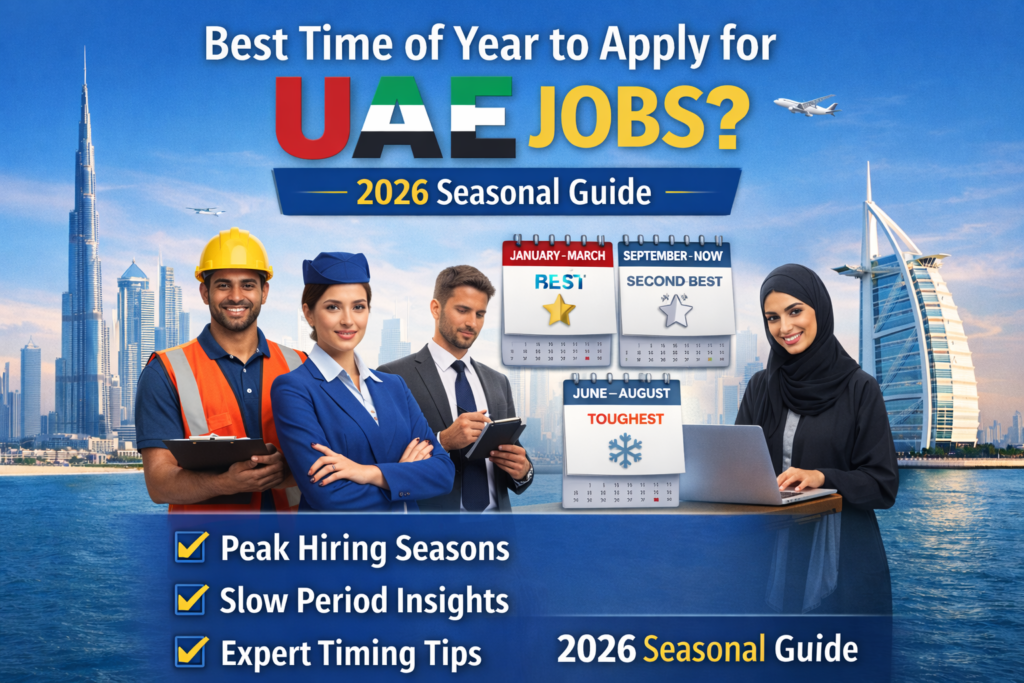
Timing is one of the most underrated success factors in the UAE job market. Many job seekers focus entirely on CV quality, interview skills, and networking—yet overlook a critical variable: the hiring calendar.
In the UAE, recruitment activity does not remain consistent throughout the year. It follows a clear seasonal rhythm shaped by:
- Fiscal-year budgeting cycles
- Climate patterns (extreme summer heat)
- Religious and national holidays
- Project-based business models
- Notice period structures
Understanding this rhythm can dramatically improve your response rate, interview invitations, and offer timelines.
If you apply at the right time, you might secure interviews within weeks. Apply during the wrong period, and even a strong CV may sit unread for months.
This comprehensive guide explains exactly when to apply, when to prepare, and when to pause.
Why Timing Matters More in the UAE Than in Other Countries
Unlike markets where hiring happens steadily year-round, the UAE operates in compressed recruitment waves.
Here’s why:
1️⃣ January–December Fiscal Year Structure
Most UAE companies operate on a calendar-year fiscal system.
- Budgets are finalized in December.
- Headcount approvals happen in late December or early January.
- Hiring targets are set at the start of Q1.
This creates a surge in job postings in January and February.
If a department receives approval for five new hires in January, they must start recruitment immediately. That urgency benefits job seekers.
2️⃣ The Summer Climate Effect
From June to August, temperatures can exceed 45–50°C.
The impact:
- Senior leaders travel abroad.
- Many employees take extended leave.
- Decision-making slows dramatically.
- New projects are postponed.
While recruitment does not completely stop, it becomes significantly slower.
3️⃣ Notice Period Planning
The UAE labor system includes structured notice periods:
- Standard: 30 days
- Mid/senior roles: 60–90 days
If a company hires someone in January, they expect that person to join by March or April.
This creates predictable forward-planning recruitment cycles.
The UAE Hiring Calendar: Month-by-Month Breakdown
Let’s analyze the year strategically.
🥇 Peak Season 1: January – March (The Prime Window)
Verdict: The Best Time to Apply
This is the most active hiring period of the year.
What Happens During This Period?
- New budgets are activated.
- Expansion projects begin.
- Departments rush to fill approved roles.
- Recruiters are highly responsive.
- Interview scheduling is fast.
Recruitment portals experience the highest volume of new postings.
Who Benefits Most?
- Entry-level candidates
- Mid-level professionals
- Senior executives
- International applicants
If you are serious about landing a role in 2026, your strongest opportunity lies in Q1.
Strategic Action Plan
- Start preparing in December.
- Update CV and LinkedIn before year-end.
- Begin applying during the first working week of January.
- Apply aggressively for 8–12 weeks.
This period offers maximum opportunity density.
🥈 Peak Season 2: September – November (The Recovery Surge)
Verdict: Second-Best Time
After the summer slowdown, the market rebounds strongly.
What Happens?
- Executives return from vacation.
- Delayed projects restart.
- Companies push to fill roles before year-end.
- Sales and corporate roles expand for Q4 targets.
There is urgency—but the window is shorter.
Hiring intensity is highest in September and October, then gradually declines by mid-November.
Who Benefits?
- Project managers
- Sales professionals
- Corporate staff
- Logistics and operations roles
If you missed Q1, this is your second major opportunity window.
🌤 Moderate Season: April – May (Steady but Competitive)
Verdict: Good but Less Urgent
The Q1 hiring wave slows but does not stop.
Market Behavior
- Remaining approved roles are filled.
- Replacement hiring continues.
- Some new business initiatives launch before summer.
However, urgency decreases.
Recruiters are more selective and less pressured.
Who Benefits?
- Candidates already inside the UAE
- Those available for immediate joining
- Niche-skilled professionals
If applying during this time:
- Emphasize immediate availability.
- Follow up consistently.
- Leverage referrals more heavily.
❄️ Slow Period 1: June – August (The Summer Slump)
Verdict: Slowest Quarter
The summer heat has a tangible economic effect.
What Happens?
- Decision-makers travel.
- HR operates with minimal staff.
- Interview rounds are postponed.
- Hiring freezes may occur.
Urgent roles still get filled—but expansion hiring slows dramatically.
What You Should Do Instead
Use this time productively:
- Attest your degree
- Complete certifications
- Upgrade technical skills
- Strengthen LinkedIn presence
- Network virtually
- Prepare documentation
Treat summer as your preparation phase for the September surge.
❄️ Slow Period 2: December (The Holiday Pause)
Verdict: Limited Activity
December splits into two halves:
Early December:
- Some interviews still occur.
- Offers may be issued.
- Start dates usually scheduled for January.
Mid to Late December:
- National Day celebrations
- Christmas and New Year holidays
- Corporate shutdowns
Recruitment activity becomes minimal.
Best Strategy
- Reflect on your approach.
- Update CV.
- Prepare for January.
- Schedule applications for first week of the new year.
Industry-Specific Hiring Patterns
While general patterns apply broadly, certain sectors follow specialized cycles.
🏫 Education Sector
Best Time: January – April
Schools recruit for September academic start dates.
Recruitment fairs and hiring rounds happen early in the year.
Applying in June for September intake is usually too late.
🏥 Healthcare
Hiring: Year-Round (Except August)
Healthcare operates continuously.
However, licensing requirements (DHA, DOH, MOH) affect timelines.
Best time to apply:
- When licensing is nearly complete
- During Q1 or Q4
✈️ Aviation & Tourism
Peak Hiring:
- August–October (for winter tourism season)
- January–March (for summer travel season)
Hotels and airlines hire in advance of peak tourist periods.
💼 Banking & Finance
Best Time:
- January–April
- September–October
Strongly aligned with fiscal year budgets and regulatory cycles.
Avoid December and audit-heavy summer months.
🏗 Construction & Engineering
Hiring tied to:
- Government project launches
- Infrastructure cycles
- Expo-style events
- Real estate expansions
Most active in Q1 and Q4.
The Visit Visa Strategy: When to Travel
If planning to visit the UAE to search for jobs, timing is critical.
Best Months to Arrive:
- Mid-January
- Mid-September
Why?
You maximize your 60-day visit visa during active hiring periods.
Worst Month to Arrive:
- July
You risk exhausting savings while decision-makers are on vacation.
Budgeting Strategy Based on Timing
If arriving during a peak season:
- Expect faster interview cycles.
- Budget for 2–3 months of expenses.
If arriving during a slow season:
- Expect longer waiting periods.
- Budget for 3–4 months.
Estimated monthly expense (shared accommodation):
3,000–5,000 AED
Recommended buffer:
15,000–20,000 AED minimum
Strategic Calendar for 2026
Here is a professional-level plan:
December 2025
- Prepare documents
- Update CV
- Complete degree attestation
- Build target company list
January – March 2026
- Apply aggressively
- Attend interviews
- Network heavily
- Track applications daily
April – May 2026
- Continue applying
- Focus on referrals
- Attend industry events
June – August 2026
- Upskill
- Certify
- Expand network
- Prepare for September push
September – October 2026
- Relaunch applications
- Reconnect with recruiters
- Follow up on previous conversations
November 2026
- Close outstanding opportunities
- Prepare for next hiring cycle
December 2026
- Strategic planning phase
Psychological Advantage of Applying at the Right Time
Applying during peak periods gives you:
- Faster responses
- More interview slots
- Greater negotiation leverage
- Higher offer probability
Applying during slow periods often leads to:
- Delayed replies
- Ghosting
- Extended silence
Timing does not replace skill—but it amplifies it.
Final Verdict: Align Your Strategy with the Market
The best time to apply for UAE jobs in 2026:
🥇 January – March
🥈 September – October
Moderate: April – May
Slow: June – August & Late December
If today is a slow month, do not panic.
Use it to prepare.
Success in the UAE job market is not about working harder—it is about working smarter and aligning with the hiring rhythm.
When you align your job search effort with the UAE’s natural recruitment cycles, you move with the current instead of against it.
And that shift alone can cut your job search time in half.
Frequently Asked Questions (FAQ)
1. What is the best time of year to apply for jobs in the UAE?
The best time to apply for jobs in the UAE is January to March, when companies receive new annual budgets and begin aggressive hiring. The second-best period is September to October, after the summer slowdown ends.
2. Why is January the peak hiring season in the UAE?
Most UAE companies operate on a January–December fiscal year. New budgets and hiring approvals are released at the beginning of the year, creating strong recruitment activity in Q1.
3. Is it difficult to get a job in the UAE during summer?
Yes, hiring slows significantly from June to August due to extreme heat and long employee vacations. Many senior decision-makers are out of the country, causing delays in interviews and approvals.
4. Is December a good month to apply for UAE jobs?
December is generally slow, especially after mid-month. While early December may still see some hiring activity, most companies pause recruitment during year-end holidays and resume in January.
5. When is the second-best hiring season in the UAE?
The second peak hiring period is September to November, particularly September and October. Companies resume recruitment after summer and rush to fill positions before year-end.
6. Do all industries follow the same hiring cycle in the UAE?
No, some industries have unique cycles:
- Education: January to April (for September academic intake)
- Healthcare: Year-round but dependent on licensing
- Aviation & Tourism: August to October and January to March
- Banking & Finance: January to April and September to October
7. Should I stop applying during slow months?
No. Instead of stopping, use slow periods to:
- Upgrade skills
- Complete certifications
- Prepare documents
- Strengthen networking
- Optimize your CV and LinkedIn profile
Strategic preparation during slow months improves results during peak seasons.
8. When is the best time to visit the UAE on a job search visa?
The best time to arrive in the UAE for job hunting is mid-January or mid-September, when hiring activity is increasing. Avoid visiting in July due to low recruitment activity.
9. Does applying at the right time increase my chances of getting hired?
Yes. Applying during peak hiring seasons increases your visibility, speeds up interview scheduling, and improves response rates because recruiters are actively looking to fill approved positions.
10. How far in advance should I prepare before peak hiring season?
Ideally, start preparing one to two months before peak season. For example, update your CV in December to apply aggressively in January, or prepare in July/August for the September hiring surge.
11. Are entry-level jobs also seasonal in the UAE?
Entry-level and high-volume roles such as retail and hospitality are less seasonal but still experience stronger hiring during January–March and September–October.
12. What is the biggest mistake job seekers make regarding timing?
The biggest mistake is applying randomly throughout the year without understanding hiring cycles. Aligning your applications with budget approvals and post-holiday recruitment periods significantly improves success rates.