
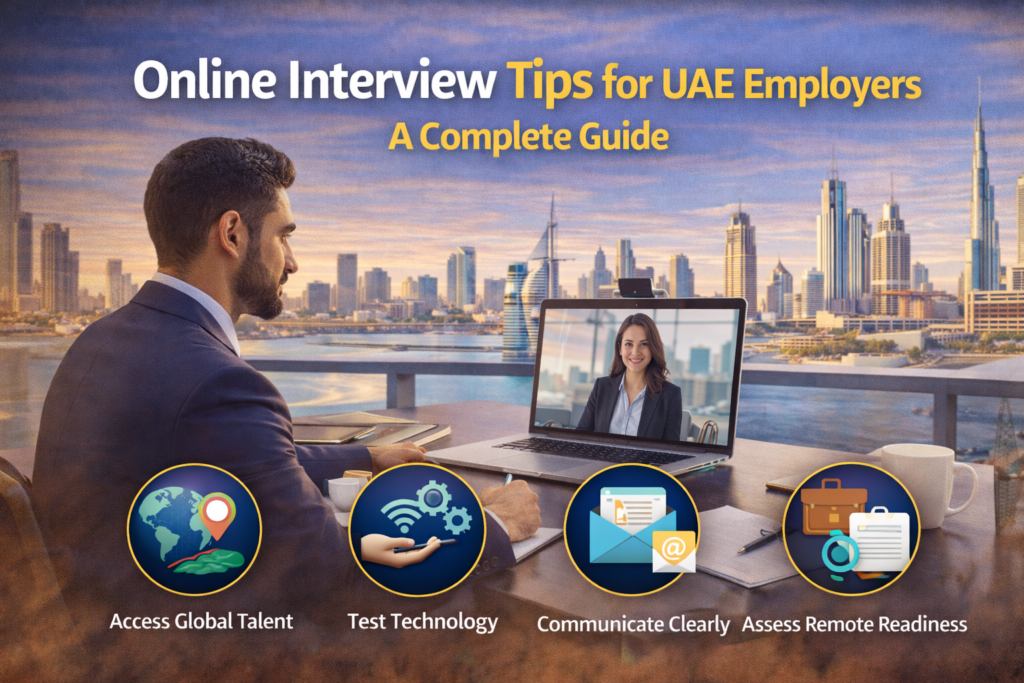
The hiring landscape in the United Arab Emirates has undergone a major transformation. What was once dominated by walk-in interviews and in-person meetings has now evolved into a hybrid and digital-first recruitment ecosystem.
With the growth of remote work models, international hiring, and flexible employment frameworks in hubs like Dubai and Abu Dhabi, online interviews have become a permanent fixture in the hiring process.
For UAE employers, mastering virtual interviews is no longer optional. It is a strategic necessity.
While much advice focuses on helping candidates prepare, employers often overlook their own role in creating a professional, efficient, and brand-enhancing virtual interview experience.
This comprehensive guide provides practical and actionable online interview tips for UAE employers to ensure you attract, evaluate, and secure top talent effectively.
Why Online Interviews Matter for UAE Employers
The UAE has positioned itself as a global business hub. Free zones, remote work classifications, and international visa programs have expanded the available talent pool beyond geographical boundaries.
Virtual interviews allow employers to:
- Access global talent without relocation barriers
- Reduce recruitment timelines
- Minimize administrative overhead
- Assess remote work readiness
- Improve hiring efficiency
For companies in fast-moving sectors like fintech, aviation, consulting, real estate, and technology, online interviews provide a significant competitive edge.
But efficiency alone is not enough. Execution matters.
Part 1: Establishing a Standardized Virtual Interview Process
One of the biggest mistakes UAE employers make is treating virtual interviews casually.
Consistency and structure are essential.
1. Define Your Platform
Choose one primary video platform for consistency:
- Zoom
- Microsoft Teams
- Google Meet
Avoid constantly switching platforms, as this creates confusion for candidates and internal teams.
Ensure:
- Licenses are active
- Meeting security is enabled
- Waiting room settings are configured properly
2. Create a Clear Internal Framework
Document the following:
- Who schedules the interview
- Who sends the link
- Who leads the interview
- Duration of each stage
- Evaluation criteria
- Scoring templates
Standardization reduces bias and ensures fairness across candidates.
3. Send Professional Interview Invitations
Candidates judge your brand based on your communication.
Your email should include:
- Date and time (with UAE time zone specified)
- Interview platform link
- Duration
- Names and titles of interviewers
- Any required documents
- Backup contact details
This level of clarity reflects strong organizational culture.
Part 2: Preparing the Virtual Environment
Remember: The candidate sees your environment too.
Your setting reflects your company’s professionalism.
1. Choose the Right Space
- Quiet room
- No interruptions
- Neutral background
- Proper lighting
Avoid:
- Open-plan noise
- Personal distractions
- Visible clutter
A clean background builds credibility.
2. Optimize Lighting and Camera Position
- Face a light source
- Avoid backlighting from windows
- Keep camera at eye level
- Ensure stable internet
Poor lighting reduces engagement and trust.
3. Test Technology in Advance
Before every interview:
- Check microphone
- Test speakers
- Verify screen-sharing functionality
- Close unnecessary applications
Nothing undermines authority faster than technical confusion.
Part 3: Starting the Interview Professionally
First impressions are powerful.
1. Begin on Time
Starting late without explanation sends a negative message.
If delays occur:
- Inform candidate immediately
- Apologize professionally
Respecting time is critical in UAE business culture.
2. Provide a Warm Introduction
Start with:
- Greeting
- Introduce yourself and panel members
- Confirm audio clarity
- Outline interview structure
Example:
“Good morning, thank you for joining us. Today’s discussion will last approximately 45 minutes and include technical and competency questions.”
This helps candidates relax and perform better.
Part 4: Assessing Candidates Effectively Online
Virtual interviews require more attentive listening because non-verbal cues are reduced.
1. Focus on Structured Responses
Encourage candidates to use structured answers such as:
Situation
Task
Action
Result
This improves clarity and allows objective evaluation.
2. Evaluate Remote Work Readiness
Ask questions such as:
- “How do you manage productivity when working remotely?”
- “How do you communicate progress with your team?”
Observe:
- Clarity
- Discipline
- Self-management
Remote readiness is now a core competency.
3. Assess UAE Market Awareness
For local roles, evaluate understanding of:
- UAE business environment
- Regional competition
- Cultural sensitivity
- Local regulations
For senior positions, test knowledge of labor laws and industry-specific compliance requirements.
Part 5: Handling Salary Discussions Transparently
Salary conversations in the UAE vary significantly depending on:
- Local vs overseas candidates
- Visa sponsorship requirements
- Relocation costs
- Housing allowances
- Health insurance
Be transparent early.
Clarify:
- Budget range
- Allowances
- Visa coverage
- Medical insurance
- Remote work terms
Avoid late-stage surprises.
Part 6: Common Mistakes UAE Employers Make in Online Interviews
❌ Multitasking During Interviews
Typing emails or checking your phone during the interview is visible and disrespectful.
Maintain full attention.
❌ Ignoring Technical Issues
If there is lag or freezing:
Acknowledge it.
Professional communication builds trust.
❌ Poor Follow-Up Communication
Never leave candidates uncertain.
After the interview:
- Inform them of timeline
- Share next steps
- Send formal confirmation
A poor follow-up damages employer brand.
Part 7: Legal Considerations for UAE Employers
Hiring remotely does not remove legal obligations.
If hiring within the UAE:
- Ensure proper work permits
- Provide health insurance
- Issue compliant employment contracts
If hiring overseas remote workers:
- Clarify visa sponsorship
- Clarify tax implications
- Define remote employee classification
Understand local regulations in free zones such as:
- Abu Dhabi Global Market
Ensure compliance with:
- Ministry of Human Resources and Emiratisation
Proper documentation protects both employer and employee.
Part 8: Enhancing Employer Branding During Online Interviews
Virtual interviews are not just evaluations — they are marketing opportunities.
Candidates assess:
- Professionalism
- Leadership style
- Communication culture
- Work environment
Showcase:
- Company vision
- Team collaboration
- Growth opportunities
- Diversity commitment
Strong employer branding attracts stronger talent.
Part 9: Cultural Sensitivity in Virtual Interviews
The UAE workforce is multicultural.
Be mindful of:
- Time zones
- Religious holidays
- Ramadan schedules
- Gender etiquette
Professional inclusivity strengthens employer reputation.
Part 10: Creating a Positive Candidate Experience
The candidate experience influences:
- Offer acceptance rates
- Online employer reviews
- Brand perception
Ensure:
- Clear communication
- Structured interviews
- Professional tone
- Respectful feedback
Even rejected candidates should leave impressed.
Part 11: Measuring Interview Effectiveness
Evaluate your process regularly.
Track:
- Time-to-hire
- Candidate satisfaction
- Offer acceptance rate
- Technical failure rate
- Interviewer consistency
Continuous improvement strengthens your recruitment engine.
Final Thoughts
Online interviews are not temporary solutions. They are a permanent evolution in the UAE hiring ecosystem.
Employers who approach virtual interviews strategically will:
- Hire better talent
- Reduce hiring costs
- Enhance employer brand
- Improve candidate experience
- Stay competitive in global talent acquisition
Technology enables connection.
But professionalism, preparation, and cultural awareness create success.
Employer Virtual Interview Checklist
✅ Standardized interview process documented
✅ Platform tested and stable
✅ Quiet, professional environment prepared
✅ Clear communication sent to candidate
✅ Salary and visa structure clarified
✅ Legal compliance verified
✅ Follow-up timeline communicated
Mastering online interviews is about balancing efficiency with empathy.
Approach each virtual interaction as both an evaluation and a representation of your company.
When done correctly, online interviews become more than screening tools — they become powerful recruitment assets in the dynamic UAE market.
Your next great hire may be just one video call away.
Frequently Asked Questions (FAQ) – Online Interview Tips for UAE Employers
1. Why are online interviews important for UAE employers?
Online interviews allow UAE employers to access a wider talent pool, including international candidates, reduce hiring costs, and speed up the recruitment process. They also help assess a candidate’s remote work readiness.
2. What platform should UAE employers use for virtual interviews?
Employers can use platforms like Zoom, Microsoft Teams, or Google Meet. The key is to standardize one platform internally and ensure it is tested and secure before each interview.
3. How can employers create a professional virtual interview environment?
Employers should conduct interviews in a quiet, well-lit room with a neutral background. The camera should be at eye level, and technical equipment should be tested beforehand to avoid disruptions.
4. What information should be included in a virtual interview invitation?
A professional invitation should include:
- Date and time (with UAE time zone)
- Platform link
- Interview duration
- Names and titles of interviewers
- Required documents or assessments
- Backup contact details in case of technical issues
5. How can employers assess candidates effectively in an online interview?
Employers should ask structured competency-based questions and listen for clear, organized answers. Evaluating communication skills, remote work readiness, and understanding of the UAE market is essential.
6. How should UAE employers handle salary discussions in virtual interviews?
Salary expectations should be discussed transparently. Employers should clarify budget range, allowances, visa sponsorship, health insurance, and relocation terms early in the process to avoid misunderstandings.
7. What common mistakes should employers avoid during virtual interviews?
Employers should avoid:
- Starting late without explanation
- Multitasking during the interview
- Ignoring technical issues
- Failing to provide clear next steps
- Conducting interviews in noisy or unprofessional environments
8. Are UAE employers required to provide visas for remote employees?
If the employee is working within the UAE, employers must typically arrange a work permit and provide health insurance as required by law. For overseas remote workers, visa obligations may differ and should be clarified in the employment agreement.
9. How important is candidate experience in virtual interviews?
Candidate experience significantly impacts employer branding and offer acceptance rates. Clear communication, respectful interaction, and timely follow-up enhance a company’s reputation in the competitive UAE market.
10. How can employers ensure legal compliance when hiring remotely in the UAE?
Employers should verify employment contracts comply with local regulations, confirm visa and work permit requirements, and align with guidelines from relevant UAE authorities to avoid legal complications.
11. Should employers provide feedback after a virtual interview?
While not always mandatory, providing feedback or at least a status update demonstrates professionalism and strengthens employer branding.
12. How can UAE employers improve their virtual interview process over time?
Employers can improve by tracking hiring metrics such as time-to-hire, offer acceptance rates, and candidate feedback, while regularly reviewing internal interview standards and technology performance.