
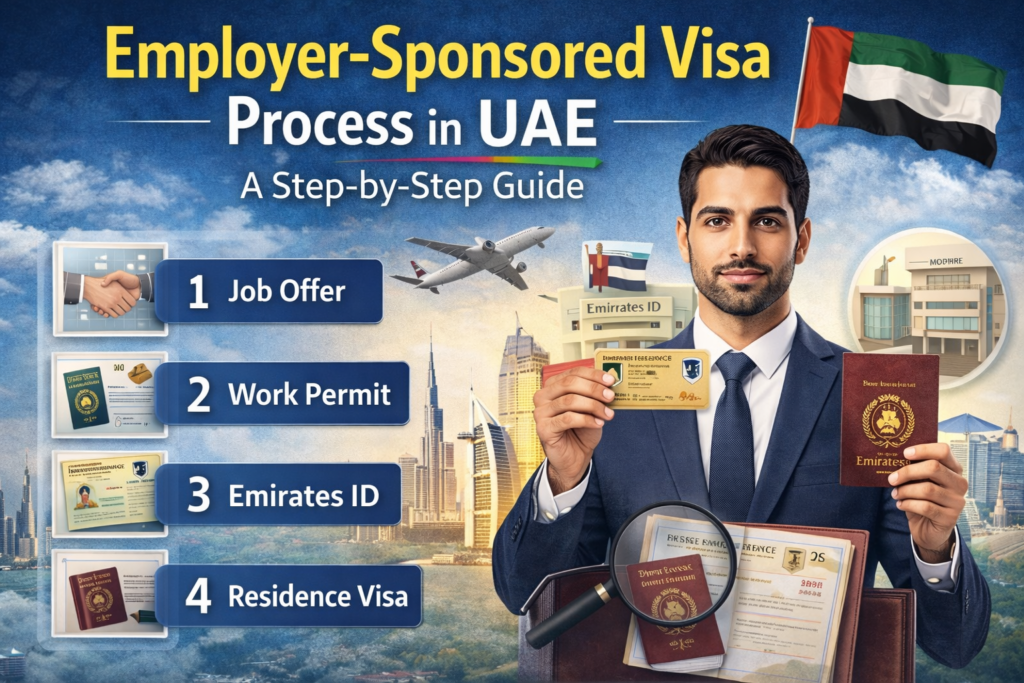
Securing a job offer in the United Arab Emirates is an exciting milestone. However, before you can officially begin working, you must complete the employer-sponsored visa process in UAE.
In the UAE, your work authorization is directly linked to your employer, who acts as your legal sponsor. This guide explains the full process—from job offer to residence visa stamping—along with eligibility criteria, required documents, timelines, costs, and compliance requirements.
What Is an Employer-Sponsored Visa?
An employer-sponsored visa (also known as a Standard Employment Visa) is a legal residency permit that allows foreign nationals to live and work in the UAE under the sponsorship of a licensed company.
Every expatriate employee must obtain:
- A Work Permit issued by the Ministry of Human Resources and Emiratisation (MoHRE)
- A Residence Visa issued by immigration authorities such as the Federal Authority for Identity, Citizenship, Customs & Port Security (ICP) or the General Directorate of Residency and Foreigners Affairs (GDRFA)
Without both approvals, you cannot legally work in the UAE.
Key Features
- Typically valid for 2 years (renewable)
- Employer acts as your legal sponsor
- Visa is tied to your employment contract
- Requires medical fitness clearance
- Includes Emirates ID registration
If your employment ends, the visa must be cancelled or transferred.
Eligibility Criteria
For Employees
You must meet the following basic requirements:
- Minimum age: 18 years
- Valid job offer from a UAE-licensed company
- Passport valid for at least 6 months
- Attested educational certificates (if required for your role)
For Employers
Your employer must:
- Hold a valid trade license
- Have available visa quota
- Be registered with MoHRE
- Comply with the Wage Protection System (WPS)
- Have no active labour or immigration violations
Required Documents
Preparing documents in advance helps avoid delays.
Personal Documents
- Passport copy (minimum 6 months validity)
- Passport-sized photographs (white background)
- Updated CV
Educational Documents
- Attested degree or diploma certificates
(Attested by home country authorities, UAE Embassy, and UAE Ministry of Foreign Affairs if required)
Employment Documents
- Signed employment contract
- Offer letter
- Employer’s trade license copy (provided by company)
Step-by-Step Employer-Sponsored Visa Process in UAE
The process typically takes:
- 7–15 working days (mainland companies)
- 5–10 working days (free zone companies)
Here’s how it works:
Stage 1: Job Offer & Work Permit Approval
Step 1: Sign the Employment Contract
Your employer issues an official offer letter detailing:
- Position
- Salary
- Benefits
- Contract duration
Once signed, the visa process begins.
Step 2: Work Permit Application
Your employer applies for a work permit through MoHRE (mainland) or the relevant free zone authority.
Processing time: 1–5 working days
Stage 2: Entry Permit Issuance
Step 3: Entry Permit Application
After work permit approval, your employer applies for an entry permit via ICP or GDRFA.
Step 4: Entry Permit Issued
You receive an entry permit valid for 60 days, allowing you to enter the UAE and complete residency formalities.
If already inside the UAE (visit visa or dependent visa), a “Change of Status” process is completed instead.
Stage 3: Medical Fitness Test
Step 5: Medical Screening
You must undergo a mandatory medical test at a government-approved center.
The test includes:
- Blood test (HIV, hepatitis screening)
- Chest X-ray (tuberculosis screening)
Results:
- Standard: Within 48 hours
- Express/VIP: Same day (in some emirates)
Medical clearance is required before visa stamping.
Stage 4: Emirates ID Registration
Step 6: Biometrics Submission
You will visit an Emirates Identity Authority center for:
- Fingerprinting
- Retina scan
- Photograph
The Emirates ID serves as your official identification in the UAE.
Processing time: 1–2 weeks
Stage 5: Residence Visa Stamping
Step 7: Labour Contract Registration
Your employer registers your labour contract with MoHRE.
Step 8: Residence Visa Issuance
Your passport is stamped with your UAE residence visa, granting legal residency.
Stage 6: Work Authorization & Employment Commencement
Step 9: Labour Card Issued
Your work permit (labour card) is officially issued.
Step 10: Receive Emirates ID
Your Emirates ID is delivered.
Step 11: Begin Employment
You can now legally start working in the UAE.
Employer-Sponsored Visa Costs
By UAE law, employers must bear all visa and recruitment costs. Employees should not pay upfront fees.
Estimated cost range (paid by employer):
| Component | Estimated Cost (AED) |
|---|---|
| Work Permit | 250 – 3,450 |
| Entry Permit | 50 – 350 |
| Medical Test | 250 – 750 |
| Emirates ID | 300 – 570 |
| Visa Stamping | 500 – 1,000 |
| Total Estimate | 2,000 – 12,000 |
Costs vary based on:
- Company category (A, B, C classification)
- Mainland vs free zone
- Employee age (additional surcharge may apply for 65+)
Processing Timeline Overview
| Stage | Estimated Time |
|---|---|
| Work Permit | 1–5 days |
| Entry Permit | 1–3 days |
| Medical Results | 48 hours |
| Emirates ID | 1–2 weeks |
| Total Duration | 2–3 weeks |
Delays may occur if:
- Educational documents require attestation
- Security clearance is required
- Application information is incomplete
How to Check Your Visa Status
You can track your visa online using:
- ICP Smart Services portal (for most emirates)
- GDRFA portal (for Dubai-issued visas)
You’ll need:
- Passport number
- Passport expiry date
- Application number (if available)
Status updates typically show:
“Received” → “Approved” → “Printed”
Common Reasons for Visa Rejection
While rare, visa rejections can occur due to:
- Failed medical screening
- Unattested or fake documents
- Employer quota limitations
- Security concerns
- Incomplete application submission
Ensuring document accuracy reduces risk significantly.
Sponsoring Family Members
Once you receive your Emirates ID and meet salary criteria, you can sponsor:
| Family Member | Minimum Salary Requirement |
|---|---|
| Spouse & Children | AED 4,000 (or AED 3,000 + accommodation) |
| Parents | Higher income threshold (approx. AED 20,000) |
Additional requirements:
- Tenancy contract (Ejari)
- Attested marriage/birth certificates
- Medical insurance
- Medical fitness (for dependents 18+)
Family visas are typically issued for 1–2 years and renewable.
What Happens If Employment Ends?
If you resign or are terminated:
- Employer cancels your visa
- You receive a grace period (typically 30 days)
- You must transfer to a new employer or exit the country
Overstaying may result in daily fines and legal restrictions.
Mainland vs Free Zone Visa: Key Differences
| Aspect | Mainland | Free Zone |
|---|---|---|
| Authority | MoHRE | Free Zone Authority |
| Processing Time | 7–15 days | 5–10 days |
| Work Location | Anywhere in UAE | Within Free Zone |
| Cost | Higher | Often bundled |
Important Compliance Requirements
Health Insurance
Health insurance is mandatory. In some emirates, employers must provide coverage; in others, employees may need to arrange their own.
Wage Protection System (WPS)
Employers must pay salaries through WPS to ensure timely and traceable payments.
Final Thoughts
The employer-sponsored visa process in UAE is structured, transparent, and efficient when handled correctly. From work permit approval to Emirates ID issuance, each stage is clearly defined and typically completed within a few weeks.
Key reminders:
- Your employer must cover visa costs
- Keep your documents attested and ready
- Complete medical and biometric steps promptly
- Verify visa status online if needed
Once your residence visa and Emirates ID are issued, you are fully authorized to live and work in the UAE—opening the door to career growth in one of the world’s most dynamic economies.
Always refer to official UAE government portals for the most up-to-date regulations and procedures.
Frequently Asked Questions (FAQ) – Employer-Sponsored Visa Process in UAE
1. What is an employer-sponsored visa in the UAE?
An employer-sponsored visa (Standard Employment Visa) is a legal residency permit that allows a foreign national to live and work in the UAE under the sponsorship of a licensed employer. The employer acts as the legal sponsor and manages the work permit and residence visa process.
2. Can I apply for an employer-sponsored visa without a job offer?
No. A valid job offer from a UAE-based company is mandatory. The employer must initiate and sponsor the visa process on your behalf.
3. How long does the employer-sponsored visa process take?
The full process typically takes 2 to 3 weeks.
- Mainland companies: 7–15 working days
- Free zone companies: 5–10 working days
Delays may occur if documents require attestation or additional approvals.
4. Who pays for the employer-sponsored visa in the UAE?
By UAE law, the employer must bear all recruitment and visa-related costs. Employees should not pay any visa processing fees. If an employer requests upfront payment, it may be a violation of labour regulations.
5. What documents are required for an employment visa?
Common required documents include:
- Passport copy (valid for at least 6 months)
- Passport-sized photographs
- Signed employment contract
- Attested educational certificates (if required for the role)
- Employer’s trade license copy (provided by employer)
6. Is a medical test mandatory for a UAE employment visa?
Yes. All applicants must undergo a medical fitness test at a government-approved health center. The test typically includes blood screening and a chest X-ray. Medical clearance is required before visa stamping.
7. What is the Emirates ID and why is it required?
The Emirates ID is the official identification card issued to UAE residents. It is mandatory for opening bank accounts, signing rental agreements, accessing government services, and completing employment formalities.
8. Can I change jobs while on an employer-sponsored visa?
Yes. You can change employers in accordance with UAE labour laws. Your current visa must be cancelled, and your new employer must initiate a transfer process before you begin working.
9. What happens if my employment is terminated?
If your job ends, your employer must cancel your visa. You are generally given a grace period (usually around 30 days) to either secure new employment and transfer your visa or leave the UAE. Overstaying may result in fines.
10. Can I sponsor my family on an employer-sponsored visa?
Yes. Once you meet the minimum salary requirement and receive your residence visa, you can sponsor your spouse, children, and in some cases, parents. You must provide proof of accommodation, income, and medical insurance.
11. What is the difference between mainland and free zone visas?
Mainland visas are regulated by the Ministry of Human Resources and Emiratisation (MoHRE) and allow you to work anywhere in the UAE. Free zone visas are issued by individual free zone authorities and typically restrict work to that specific free zone.
12. Is there an age limit for a UAE employment visa?
Generally, the minimum age is 18 years. Employment is commonly permitted up to 60 years, with possible extensions to 65 years in certain cases, subject to additional fees.