
Introduction
You’ve carefully structured your CV.
You’ve quantified your achievements.
You’ve tailored it to the job description.
But now comes one of the most confusing questions in the UAE job market:
Should you include a photo on your CV?
Some people say it’s expected.
Others warn it leads to discrimination.
Recruiters often disagree.
The truth?
There is no universal rule in the UAE — it depends on your industry, company type, and role.
This guide will help you make the right decision based on:
- UAE hiring culture
- Industry expectations
- Pros and cons
- When a photo helps
- When a photo hurts
- How to include it professionally
By the end, you’ll know exactly what to do.
Why This Question Is Complicated in the UAE
The UAE sits between Western and Middle Eastern hiring practices.
In Western countries (UK, USA, Canada):
Photos on CVs are discouraged due to anti-discrimination laws.
In many Middle Eastern and Asian countries:
Including a professional photo is normal and often expected.
The UAE blends both systems.
Because the country has:
- 200+ nationalities
- Local family-owned companies
- Large multinational corporations
- Government entities
- Free zone companies
Different employers follow different norms.
That’s why there’s no single rule.
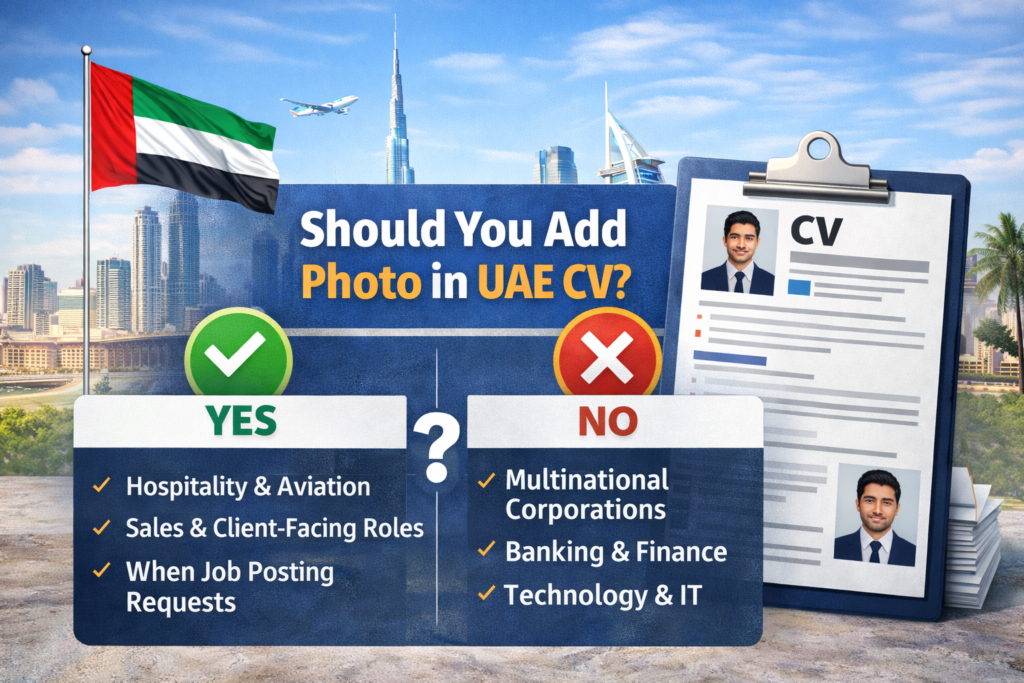
Industries Where Including a Photo Is Recommended
In some industries, a professional photo is standard and sometimes expected.
Hospitality & Tourism
Hotels, resorts, restaurants, and tourism companies value presentation and personal interaction.
Recommendation: Include a professional headshot.
Aviation (Cabin Crew & Ground Staff)
Airlines like Emirates and Etihad often require photos — sometimes full-length images.
Recommendation: Include photo (follow job posting instructions exactly).
Sales & Client-Facing Roles
If your role involves:
- Meeting clients
- Representing a brand
- Luxury retail
- Real estate
- Business development
A professional image can support your application.
Recommendation: Include a photo if it aligns with brand expectations.
Healthcare (Patient-Facing Roles)
Doctors, nurses, and healthcare staff sometimes include photos to build trust and connection.
Recommendation: Optional but acceptable.
Beauty, Wellness, Modeling & Entertainment
These industries typically require photos.
Recommendation: Include high-quality professional images.
Industries Where Photos Are Usually NOT Recommended
Banking & Finance
Many multinational banks follow global HR standards that discourage photos.
Recommendation: Do not include a photo unless requested.
Technology & IT
The tech sector focuses on skills, portfolios, and technical competence.
Recommendation: Skip the photo.
Engineering & Construction
Technical qualifications and project experience matter most.
Recommendation: Photo not necessary.
Multinational Corporations (MNCs)
Companies headquartered in the US, UK, or Europe often prefer no-photo CVs.
Recommendation: Omit photo unless specifically requested.
Legal & Professional Services
International law firms and consulting firms typically avoid photos.
Recommendation: Do not include a photo.
Pros and Cons of Adding a Photo
Advantages
- Creates personal connection
- Makes your CV memorable
- Aligns with traditional business culture
- Helps in presentation-focused industries
- Can support brand alignment (luxury sectors)
Disadvantages
- Risk of unconscious bias
- Age, race, or appearance discrimination
- Poor-quality photos damage credibility
- Takes up valuable space
- May conflict with multinational HR policies
The Discrimination Factor
This is the strongest argument against including a photo.
Research globally shows:
- Attractive candidates are statistically favored
- Older candidates may face bias
- Unconscious racial or gender bias can occur
While UAE laws prohibit discrimination, unconscious bias still exists.
If you’re concerned about being judged based on appearance, omitting the photo is completely acceptable.
If You Include a Photo: Do It Professionally
If you decide to add a photo, follow strict standards.
DO:
- Use a professional headshot
- Wear business attire suitable for your industry
- Use neutral background (white, grey, light blue)
- Maintain natural, professional expression
- Use good lighting
- Keep photo recent (1–2 years old)
- Place it top-right corner
- Keep it small (passport-size style)
DON’T:
- Use selfies
- Use vacation photos
- Use heavily edited or filtered images
- Use group photos
- Use casual clothing
- Use outdated photos
- Let the photo dominate the page
Photo Technical Guidelines
- Size: Small (2–3 cm square)
- Format: JPEG or PNG
- Resolution: Clear but optimized
- File Size: Entire CV under 2MB
- Save as: PDF
If You Skip the Photo
That’s perfectly fine.
Instead:
- Use a strong professional summary
- Highlight achievements clearly
- Optimize LinkedIn profile with professional photo
- Add LinkedIn URL on CV
Recruiters will often check LinkedIn anyway.
Decision Framework
Use this checklist:
1. Does the job posting request a photo?
If YES → Include one
If NO → Move to next step
2. Is it a multinational company?
Yes → Skip photo
No → Consider industry norms
3. Is it hospitality, aviation, sales, retail?
Yes → Include professional photo
4. Is it banking, tech, consulting, engineering?
Yes → Skip photo
5. Still unsure?
Safer option: Do not include photo.
Regional Differences in the UAE
Dubai
More multinational, mixed practices.
Abu Dhabi
More government & traditional sectors.
Other Emirates
More local companies; photos more common.
Always research company culture.
Best Compromise Strategy
If unsure:
- Do NOT include photo on CV
- Use strong LinkedIn profile with professional photo
- Add LinkedIn link prominently
This avoids bias during screening but keeps your image accessible.
Final Verdict: Should You Add Photo in UAE CV?
Include a Photo If:
- Applying to hospitality, aviation, luxury retail
- Applying to local/traditional companies
- Job posting specifically requests it
- Client-facing roles
- You have a high-quality professional photo
Skip the Photo If:
- Applying to multinational corporations
- Applying in banking, tech, consulting, engineering
- Not requested in job description
- You lack a professional-quality image
- Concerned about bias
Key Takeaways
- There is no universal rule in the UAE.
- Industry and company culture determine expectations.
- A bad photo hurts more than no photo.
- LinkedIn can substitute for CV photo.
- When in doubt, skip the photo.
Conclusion
Your CV’s purpose is to communicate your value — not your appearance.
A professional photo can support your application in certain industries, but in many corporate roles, it is unnecessary.
The safest approach?
Research each company.
Follow job instructions.
Prioritize your achievements.
Whether you include a photo or not, what truly matters is that your CV clearly demonstrates why you are the right candidate.
Frequently Asked Questions (FAQs)
1. Is it mandatory to add a photo in a UAE CV?
No, adding a photo is not mandatory in the UAE. While it is common in certain industries like hospitality, aviation, and retail, many multinational companies and corporate sectors do not require or prefer photos.
2. Do UAE employers prefer CVs with photos?
It depends on the industry and company culture. Local and customer-facing industries often expect photos, while multinational corporations and corporate sectors typically prefer CVs without photos to reduce bias.
3. Which industries in the UAE require a photo on a CV?
Photos are commonly expected in:
- Hospitality and tourism
- Aviation and cabin crew roles
- Luxury retail and real estate
- Sales and client-facing roles
- Modeling and entertainment
Always check the job description for specific requirements.
4. Should I include a photo when applying to multinational companies in Dubai?
Generally, no. Multinational corporations usually follow Western HR practices and prefer CVs without photos to maintain objectivity in the screening process.
5. What type of photo should I use if I decide to include one?
Use a professional headshot with:
- Business attire suitable for your industry
- Neutral background
- Good lighting
- Natural, professional expression
- Recent appearance (within 1–2 years)
Avoid selfies, casual photos, and heavily edited images.
6. Where should the photo be placed on a UAE CV?
If included, place the photo at the top right corner of the first page. Keep it small and ensure it does not dominate the layout or reduce space for important content.
7. Can including a photo lead to discrimination?
Yes, including a photo may introduce unconscious bias based on age, gender, or appearance. This is one reason many corporate employers prefer CVs without photos.
8. What if the job posting does not mention a photo requirement?
If the job posting does not specify, research the company culture. If unsure, it is generally safer to omit the photo—especially for corporate, banking, or tech roles.
9. Is it better to include a photo on LinkedIn instead of the CV?
Yes. A professional LinkedIn profile photo is highly recommended. Recruiters in the UAE frequently check LinkedIn profiles, so including your photo there provides personal connection without adding it to your CV.
10. Should freshers include a photo on their UAE CV?
For freshers, it depends on the industry. In hospitality, retail, and customer-facing roles, including a professional photo may help. For corporate or multinational roles, it is not necessary.