
Introduction
If you are applying for jobs in Dubai, Abu Dhabi, or anywhere in the UAE, you have probably seen the terms CV and resume used interchangeably. This often creates confusion:
- Are they the same thing?
- Does it matter which one I submit?
- Do UAE employers prefer a CV or a resume?
The short answer is: Yes, there is a difference — but in the UAE, the distinction works slightly differently than in Western countries.
This guide will clearly explain:
- The difference between a CV and a resume
- What UAE employers actually expect
- When to use each format
- UAE-specific elements you must include
- How to structure your document properly
By the end of this article, you will know exactly what document to use for your UAE job applications.
What Is a CV?
A CV (Curriculum Vitae) is a detailed document that outlines your entire academic and professional history.
The term comes from Latin and means “course of life.” It is comprehensive and includes everything relevant to your career journey.
Key Features of a CV
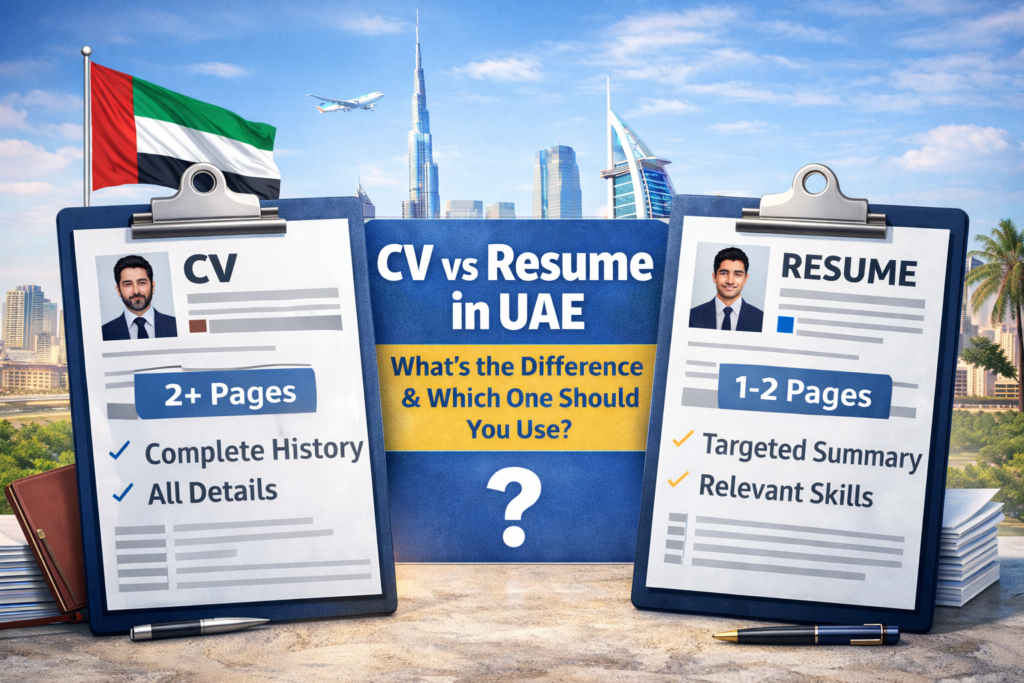
- Typically 2+ pages (can be longer)
- Includes full academic background
- Lists all work experience
- Contains publications, research, conferences
- Includes certifications, memberships, awards
- Used mainly for academic and research roles
A CV provides a complete professional biography, especially useful in fields where credentials matter deeply.
What Is a Resume?
A resume is a concise, targeted summary of your experience and skills, tailored for a specific job.
The word comes from French and means “summary.”
Key Features of a Resume
- 1–2 pages maximum
- Focused on relevant experience only
- Achievement-driven
- Customized for each application
- Designed for quick scanning
Recruiters typically spend 6–8 seconds reviewing a document before deciding whether to shortlist a candidate. A resume is built specifically for that reality.
CV vs Resume: Core Differences
| Aspect | CV | Resume |
|---|---|---|
| Length | 2+ pages | 1–2 pages |
| Purpose | Complete career history | Targeted marketing document |
| Customization | Mostly static | Customized per job |
| Content Focus | Academic & professional depth | Relevant achievements |
| Best For | Academia, research, licensing | Corporate & private sector |
Simple Analogy
A CV is like a full biography.
A resume is like a highlight reel.
Which One Do UAE Employers Prefer?
Here’s where things get interesting.
In the UAE, the word “CV” is commonly used, even when employers actually expect a resume-style document.
So when a UAE job posting says “Send your CV,” they usually mean:
- 1–2 pages
- Achievement-focused
- Professionally formatted
- Tailored to the job
- Includes UAE-specific details
In most corporate sectors, employers want a resume-style CV.
Industry-Specific Preferences in the UAE
Full CV Required For:
- Academic positions
- University faculty roles
- Research institutions
- Healthcare licensing applications
- Government sector roles
Resume-Style CV Preferred For:
- Banking and Finance
- Corporate roles
- Technology
- Marketing & Sales
- Retail & Hospitality
- Engineering (except research-focused roles)
- Entry-level positions
For most private sector roles in Dubai and Abu Dhabi, keep your document to 2 pages maximum.
UAE-Specific Elements You Must Include
Unlike Western resumes, UAE employers expect certain additional details.
Essential Information for UAE Applications:
- Full Name
- Professional Title
- Phone Number (+971 if available)
- Professional Email
- LinkedIn Profile
- Current Location
- Nationality
- Visa Status
- UAE Driving License (if applicable)
- Languages
Visa Status Example:
- Employment Visa (Valid until Oct 2025)
- Family Visa
- Visit Visa (Available immediately)
- Outside UAE – Willing to relocate
Visa transparency is extremely important in the UAE job market.
The Rise of Skills-Based Hiring in the UAE
Hiring practices are evolving globally, including in the UAE.
Employers increasingly look for:
- Demonstrated skills
- Measurable outcomes
- Practical experience
- Case studies and work samples
Your document should focus on:
- Quantifiable achievements
- Impact-driven statements
- Leadership scope
- Business results
Example:
Weak: Managed a sales team.
Strong: Led a team of 15 sales executives, increasing annual revenue by 32% (AED 18M).
The Best Approach: The UAE-Optimized CV
For most professionals, the safest strategy is a hybrid:
- 1–2 pages
- Achievement-focused
- Includes UAE-specific details
- Clean and ATS-friendly
- Tailored to each job
This approach satisfies local expectations while remaining recruiter-friendly.
Common Mistakes to Avoid
For Freshers:
- Submitting a 3-page CV with irrelevant details
- Not tailoring to the job
- Omitting projects and internships
For Experienced Professionals:
- Writing a 5+ page CV
- Listing responsibilities instead of achievements
- Not including visa status
- Using outdated format
Universal Mistakes:
- Unprofessional email address
- No measurable results
- Poor formatting
- Grammar errors
- Not optimizing for ATS
How to Make Your CV/Resume ATS-Friendly
Most UAE employers use Applicant Tracking Systems (ATS).
To optimize:
- Use standard headings (Work Experience, Education)
- Avoid graphics and tables
- Include keywords from the job description
- Use clean fonts (Arial, Calibri, Times New Roman)
- Save as PDF (unless Word requested)
Do You Need a Cover Letter in the UAE?
Not always mandatory, but highly recommended.
A short cover letter can:
- Show motivation
- Explain career transitions
- Highlight interest in the company
- Increase shortlisting chances
Keep it under one page.
Frequently Asked Questions
Do UAE employers prefer CV or resume?
They use the term “CV,” but typically expect a concise, resume-style document.
How long should my CV be?
1–2 pages for most roles. Up to 3 pages for senior professionals.
Should I include a photo?
Optional. Preferred in hospitality and customer-facing roles.
Is visa status important?
Yes. Always include it.
Can I use the same CV for every job?
No. Customization significantly improves your chances.
The Bottom Line
In the UAE job market:
The term used is “CV.”
The format expected is “resume-style.”
Your document should be:
- Concise
- Achievement-focused
- Customized
- UAE-ready
- Professionally formatted
Whether you call it a CV or a resume doesn’t matter as much as how effectively it communicates your value.
Focus on results.
Quantify impact.
Include UAE-specific details.
Do that — and your document will work.