
If you’re planning to build or advance your career in the UAE, one question matters more than anything else:
How long will it actually take to get hired?
In 2026, the UAE job market is active—but highly competitive. Hiring demand remains strong across technology, aviation, healthcare, logistics, and retail. However, companies are more selective, interview rounds are longer, and documentation requirements are stricter.
The short answer?
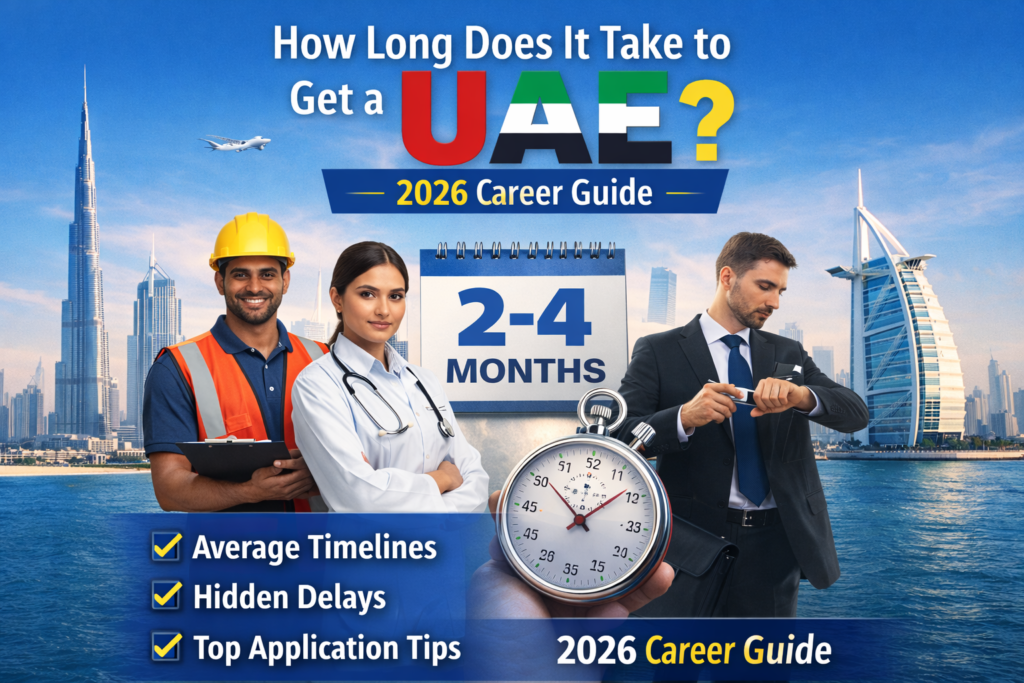
👉 Plan for 2 to 4 months for most professional roles.
👉 Entry-level roles can close in 2 to 6 weeks.
👉 Senior or licensed roles may take 4 to 6 months.
Here is a realistic, professional breakdown of what to expect.
The 2026 UAE Job Market Reality
The UAE job ecosystem is shaped by two simultaneous forces:
- High employer hiring intent
- High employee job-switching activity
Many professionals already working in the UAE are actively exploring new opportunities. This means competition is not just international—it is local and experienced.
At the same time, businesses across Dubai and Abu Dhabi are expanding in sectors like:
- Technology & AI
- Aviation & logistics
- Healthcare
- Construction & infrastructure
- Retail & hospitality
Opportunities exist—but timelines depend heavily on your industry and seniority.
The Standard Hiring Timeline (Step-by-Step)
Here’s how the process typically unfolds:
1️⃣ Application & Shortlisting (1–4 Weeks)
After submitting your CV:
- It is screened by an Applicant Tracking System (ATS).
- If it passes keyword filters, it goes to a recruiter.
- Recruiters may take 1–3 weeks to respond due to application volume.
For competitive corporate roles, this stage often takes longer.
For retail or hospitality roles, it can move much faster.
2️⃣ Interviews & Assessments (2–4 Weeks)
Most UAE employers conduct multiple interview rounds.
Typical structure:
- HR screening call
- Hiring manager interview
- Technical or skills assessment
- Final leadership round (for mid/senior roles)
For technology and AI roles:
- Live coding or take-home assignments are common.
For marketing or strategy:
- Case studies or presentations may be required.
Companies in 2026 prioritize risk reduction—expect thorough evaluation.
3️⃣ Offer Stage & Salary Negotiation (1–2 Weeks)
After verbal confirmation:
- HR prepares the official offer letter.
- Internal approvals are completed.
- Salary negotiations may occur.
With rising housing costs in Dubai and Abu Dhabi, many candidates negotiate housing allowance adjustments.
This stage usually takes 1–2 weeks.
4️⃣ Notice Period & Visa Processing (1–3 Months)
If you are currently employed:
- Standard notice period: 30 days
- Mid/senior professionals: 60–90 days
Once you sign the offer:
- Work visa and residency processing begins.
- The UAE’s Work Bundle system has reduced processing time significantly.
- In many cases, visa formalities are completed within 5–10 working days.
This is often the longest waiting phase in the entire process.
Timelines by Industry (2026)
Different sectors move at different speeds.
Technology & IT (Developers, Data, AI)
⏳ Timeline: 1–2 months
Main delay: Multiple technical assessments
Fast-growing sector but highly selective. Expect structured interviews and project-based evaluation.
Healthcare (Doctors, Nurses)
⏳ Timeline: 3–6 months (if not licensed)
Main delay: Professional licensing
Healthcare professionals must obtain licensing through local authorities (e.g., DHA, DOH). Degree verification and exams can significantly extend timelines.
If already licensed, hiring can happen within 30–45 days.
Sales, Retail & Hospitality
⏳ Timeline: 2–4 weeks
Main delay: Interview scheduling
This is the fastest-moving sector. Walk-in interviews are common. Offers are sometimes issued within days.
Construction & Engineering
⏳ Timeline: 1–2 months
Main delay: Project-based hiring cycles
Hiring often aligns with project launches. Engineers may need professional registration depending on employer requirements.
Education (Teachers & Academic Staff)
⏳ Timeline: 4–8 months
Main delay: Academic calendar
Most schools recruit for September intake, with interviews starting in January–March. Late applicants may need to wait for the next cycle.
By Seniority Level
| Level | Expected Timeline | Why |
|---|---|---|
| Entry-Level | 4–6 Weeks | Faster screening, minimal negotiation |
| Mid-Level | 2–3 Months | Multiple interviews + notice period |
| Senior Manager | 4–6 Months | Extensive evaluation + long notice period |
Hidden Delays That Can Extend Your Timeline
Even after receiving an offer, delays may occur.
1️⃣ Degree Attestation
Your degree must be:
- Attested in your home country
- Stamped by UAE Embassy
- Approved by UAE Ministry of Foreign Affairs
This process may take 3–5 weeks.
Professional advice: Start attestation early.
2️⃣ Security Clearance
Every employment visa undergoes background screening.
While often cleared quickly, delays of 2–3 weeks are possible.
3️⃣ Seasonal Slowdowns
Hiring activity drops significantly during:
- July & August (summer holidays)
- December (year-end holidays)
Decision-makers may be unavailable, causing extended waiting periods.
Best Time to Apply in the UAE
Timing can significantly reduce your job search duration.
🔥 Peak Hiring Season 1: January – March
- New budgets approved
- High recruitment activity
- Best time to apply
🔥 Peak Hiring Season 2: September – November
- Post-summer recruitment surge
- Strong for corporate and project roles
⚠️ Slower Months:
- June – August
- December
Use slower months for networking and preparation.
Financial Planning: How Much Should You Save?
If you relocate on a visit visa to search for work, budget carefully.
Average monthly expenses (basic lifestyle):
- Accommodation (shared): 1,500–3,000 AED
- Food & transport: 1,500–2,000 AED
Estimated total: 3,000–5,000 AED per month
For a 3-month job search, maintain at least:
👉 15,000–20,000 AED in savings
This prevents financial stress during interviews.
Final Verdict: Plan Strategically
In 2026, getting a job in the UAE is not instant—but it is achievable with preparation.
Realistic expectations:
- Entry-level roles: 1 month
- Professional roles: 2–4 months
- Senior or licensed roles: 4–6 months
Success depends on:
- ATS-optimized CV
- Early document preparation
- Strategic timing
- Strong networking
- Financial planning
Treat your UAE job search as a structured project—not a last-minute trip.
If you prepare properly and time your move intelligently, your chances of securing the right role improve significantly.
Frequently Asked Questions (FAQ)
1. How long does it take to get a job in the UAE in 2026?
For most professional roles, it typically takes 2 to 4 months from application to joining date. Entry-level jobs may take 2 to 6 weeks, while senior or licensed roles can take 4 to 6 months depending on interviews, notice periods, and documentation.
2. Why does the UAE hiring process take time?
The hiring process in the UAE can take time due to multiple interview rounds, technical assessments, internal approvals, salary negotiations, and visa processing. Companies in 2026 are more cautious and selective when hiring.
3. What is the fastest sector to get hired in the UAE?
Retail, hospitality, and high-volume sales roles are usually the fastest. Many companies conduct walk-in interviews and may issue offers within days or weeks.
4. Which jobs take the longest to secure in the UAE?
Senior management roles, healthcare positions requiring licensing, and teaching jobs tied to academic cycles often take the longest. These roles may require extensive interviews, degree verification, and regulatory approvals.
5. How long does UAE visa processing take after getting a job offer?
Once you sign the offer letter, the work visa process can be completed in 5 to 10 working days in many cases. However, security checks or documentation issues may extend this timeline.
6. Does being inside the UAE speed up the hiring process?
Yes. Employers often prefer candidates who are already inside the UAE because they can attend in-person interviews and join quickly. Being physically present may reduce overall hiring time.
7. How long is the notice period in the UAE?
The standard notice period in the UAE is 30 days, but mid-level and senior professionals may have notice periods of 60 to 90 days, which can delay joining dates.
8. When is the best time to apply for jobs in the UAE?
The best hiring periods are:
- January to March (after new budgets are approved)
- September to November (post-summer recruitment surge)
Hiring typically slows down in July–August and December.
9. Can I get a job in one month in the UAE?
Yes, it is possible—especially for entry-level roles in retail, hospitality, or customer service. However, corporate and mid-level roles usually take longer due to structured hiring processes.
10. How much money should I save before coming to the UAE to search for a job?
It is recommended to save at least 15,000 to 20,000 AED to cover approximately three months of living expenses while job hunting.
11. Does degree attestation affect hiring timelines?
Yes. Degree attestation can take 3 to 5 weeks and may delay visa processing if not completed in advance. It is advisable to start this process early.
12. What can I do to speed up my job search in the UAE?
To reduce your job search timeline:
- Prepare an ATS-friendly CV
- Complete document attestation early
- Apply during peak hiring seasons
- Network actively on LinkedIn
- Attend walk-in interviews
- Be flexible with salary expectations initially